From combines and balers to ploughs, farmers are rethinking how and when they invest in used machinery. Rather than making reactive purchases, many are adopting a more strategic approach: planning ahead and carefully analysing their machinery needs to maximise return on investment.
[Dubai, UAE – 28 April 2026] There is a moment, just before spring takes hold, when farms across Europe shift from quiet to kinetic. Fields are prepared, plans are set in motion and machinery – perhaps the most critical tools in modern agriculture – comes sharply into focus.
For many farmers, this is no longer a reactive purchase cycle, but a deliberate one. Used machinery is increasingly seen as a practical alternative to buying new, offering access to high-performance equipment without the significant capital outlay required for brand-new models, particularly when machinery may only be needed intensively during specific periods of the year.
As Forgest Potka, Head of Agricultural Machinery Sales EMEA at Ritchie Bros., explains, the rhythm of machinery buying is closely tied to both seasonality and financial timing. Arable farmers typically sell their crops through the winter months, securing stronger prices and, crucially, liquidity. By early spring, they are in a position to reinvest. It creates a narrow but intense window of decision-making – one where preparation meets purchasing power.
“We’re seeing farmers approach machinery buying far more strategically,” says Potka. “It’s no longer about reacting to an urgent need – it’s about planning for performance and return.”

The key performance card
Historically, used machinery purchases often carried an element of compromise. Price played a dominant role and – given that farmers used to buy machines close to home – decisions could be driven as much by availability as by suitability. That dynamic is shifting.
Historically, sourcing used machinery was a local exercise. Farmers would buy from neighbours, through word of mouth, or from trusted agricultural dealers within their locality. Today, that radius has expanded dramatically. Online platforms have opened up access to a far broader pool of equipment, allowing farmers to compare machines nationwide and even across borders – and buy with greater confidence. For Ritchie Bros., one of the world’s largest equipment auctioneers, this shift has translated into significant growth in its agricultural segment in recent years.
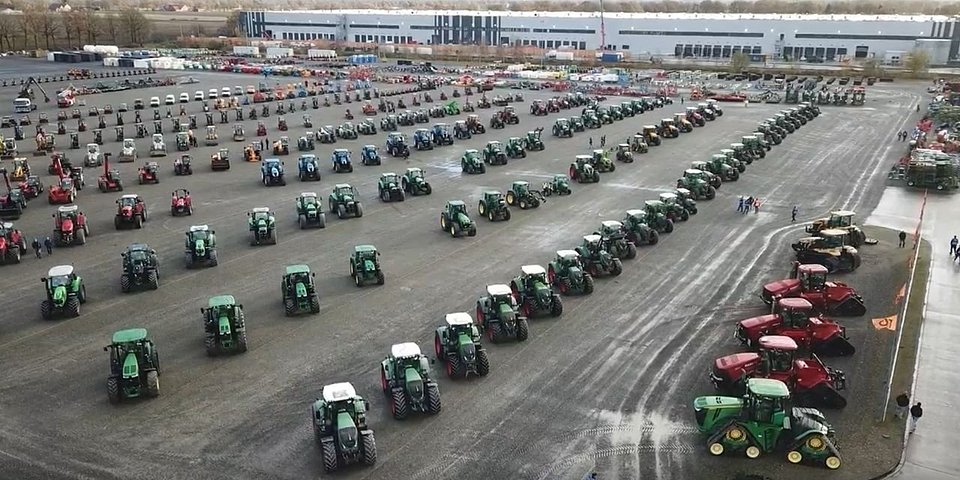
At a recent auction in Meppen, Germany, 4,026 bidders from 56 countries took part, with international participants accounting for almost half (46%) of total bidders, while 778 buyers secured equipment and 38% of purchases came from outside Germany – underlining both the scale of demand and the increasing willingness of farmers to buy remotely.
“Farmers are no longer limited by geography,” Potka explains. “They’re willing to look further afield to find the right machine, in the right condition, at the right time.”
Today’s farmers are increasingly focused on quality, condition and output. Potka points to a recent Meppen auction example: two near-identical potato harvesters, same model and year, achieved vastly different results – €76,000 for a well-maintained machine versus €28,000 for a scruffy counterpart. The lesson is clear. The market is no longer forgiving of neglect.
This reflects a broader evolution in mindset. Farmers are not simply operators, but rather business owners managing margins, productivity and risk. Machinery is no longer just a tool – it is a strategic investment that directly influences yield, efficiency and profitability.
Reliability at a premium
With this shift comes a sharper focus on reliability and brand. In a sector where timing is everything – where a delayed harvest or failed seeding window can have a big knock-on effect on farm finances – equipment must perform consistently. Farmers are increasingly willing to pay for machines that deliver dependable results. This has reinforced the used values of established manufacturers, whose reputations are built on durability and performance. It also underpins pricing across the used equipment market, where condition, maintenance history and brand perception all play a role in determining value.
Buying cheaply can quickly become expensive
“A machine that fails to meet operational expectations can end up costing far more than any initial saving,” says Potka. “Reliability has become non-negotiable.”
Perhaps the most telling change is behavioural. Emergency purchases still happen, but they are no longer the norm. Farmers are planning ahead, aligning machinery investments with seasonal cycles and operational needs. Winter becomes a period not just of rest, but of reflection and preparation. By the time spring arrives, decisions are already forming.
This more considered approach reduces risk and improves outcomes. It also signals a broader professionalisation of the sector, where data, experience and foresight increasingly guide decision-making. Taken together, these shifts point to a market that is maturing.
Farmers are becoming more analytical in their approach, machinery more sophisticated in its design and transactions more reflective of long-term value. The days of buying purely on instinct or necessity – and locally – are giving way to a more strategic mindset.
And as agriculture continues to evolve, machinery purchasing will remain at the heart of that transformation – not as a routine transaction, but as a critical business decision.
About Ritchie Bros.
Ritchie Bros., an RB Global, Inc. (NYSE: RBA) (TSX: RBA) company, is a global asset management and disposition company, offering customers end-to-end solutions for buying and selling used heavy equipment, trucks and other assets. Operating in a number of sectors, including construction, transportation, agriculture, energy, mining, and forestry, the company's selling channels include: Ritchie Bros. Auctioneers, the world's largest industrial auctioneer offering auction events with online bidding; IronPlanet, an online marketplace with weekly featured auctions and providing the exclusive IronClad Assurance® equipment condition certification; Marketplace-E, a controlled marketplace offering multiple price and timing options; and Mascus, a leading European online equipment listing service. For more information about Ritchie Bros., visit rbauction.com or for more information on RB Global, visit rbglobal.com.